
Heat · 6 min read
How hot does artificial turf get, and how do you keep it cooler?
Turf runs hotter than grass in full sun. Here is what the research measured and what makes a real difference at home.
Updated · By The Turf Factory
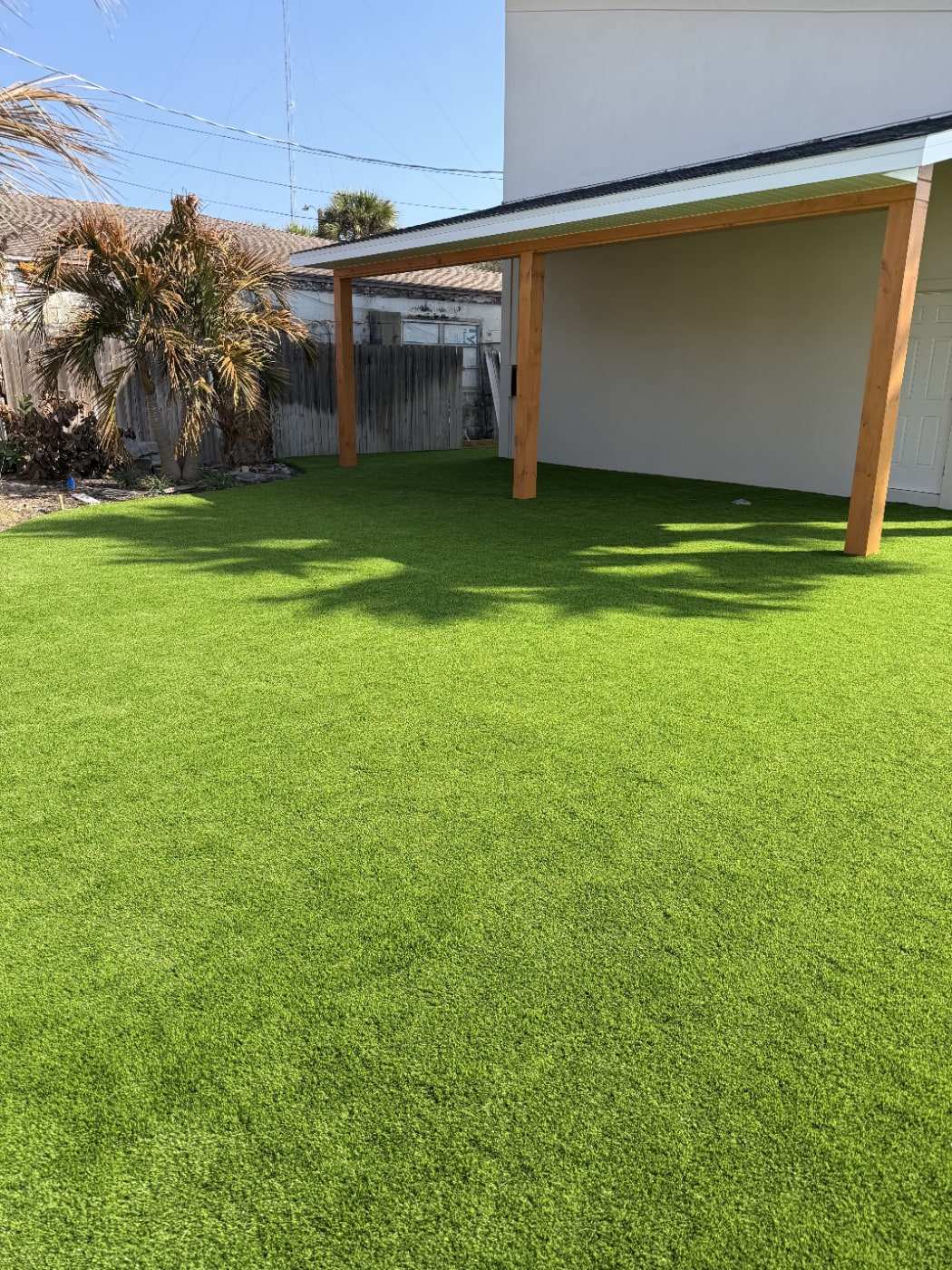
The short answer
In direct sun, artificial turf gets much hotter than natural grass. University tests have recorded surfaces from about 120°F to over 170°F on days in the 70s to 90s, with a reported peak of 200°F. Shade, a quick rinse before use and good planning around reflective windows help most, but no product makes turf as cool as living grass.
How hot does artificial turf get in the sun?
In direct sun, artificial turf runs far hotter than the air around it and far hotter than natural grass. How hot depends mostly on how strong the sunlight is, not just the air temperature.
Here is what researchers have measured, with the conditions they reported:
- Brigham Young University, June 2002: the synthetic field averaged 117°F at the surface, while natural grass averaged 78°F and asphalt 110°F. A maximum of 200°F was reported on the same field (New York State Department of Health).
- University of Missouri: on a sunny 98°F day, a turf specialist reported a surface temperature of 178°F on the university’s synthetic field, and 138°F air temperature at head height.
- Penn State test plots: on three days with average air temperatures of 79°F, 78°F and 85°F, average surface temperatures on nine infilled turf systems were 120°F, 130°F and 146°F.
- Penn State, June 6, 2011: with clear skies and air at 73–79°F, a standard green-fiber, black-rubber plot hit maximums between about 157°F and 169°F during the afternoon.
Most of this research was done on athletic fields with crumb rubber infill. Backyard turf is a different build, but the core physics is the same: blades in full sun absorb heat, and there is no living plant pulling water through to cool them.
Why turf gets hotter than grass
Grass cools itself by releasing water. Synthetic fibers can’t, so they keep absorbing sunlight until the surface is well above air temperature.
The New York State Department of Health notes the highest temperatures happen when turf is in direct sun and the fibers absorb solar radiation, and that surface temperatures drop quickly when clouds move in. A 2024 peer-reviewed study in Amsterdam found the same pattern: surface temperature tracked incoming sunlight. Conventional turf with rubber infill reached up to 67.7°C (about 154°F), while natural grass topped out at 46.8°C (about 116°F) over the same summer.
For Florida and Texas yards, that means the midday and afternoon sun is the main thing to plan around.
Does watering turf cool it down, and for how long?
Yes, but only for a short time. Water drops the surface temperature fast, then the sun heats it back up within minutes.
- At BYU, watering cut the surface from 174°F to 85°F. It climbed back to 120°F within five minutes and 164°F within twenty minutes.
- In one Penn State test, surfaces of about 130°F to 160°F dropped to about 75°F after watering, then rose to about 90°F to 120°F within 30 minutes and held there for the three-hour monitoring period.
Penn State’s researchers concluded that irrigated turf did stay cooler than unirrigated turf after three hours, but the lowest temperatures could not be held for the length of a typical game. For a homeowner, the practical takeaway is simple: hose the turf down right before kids or dogs go out on a hot afternoon, and expect the effect to fade quickly. It also helps with routine cleaning, covered in our maintenance guide.
What actually keeps turf cooler
Shade does the most, because sunlight is what drives the heat. Fiber color, infill and blade shape make smaller differences than most marketing suggests.
- Shade. Trees, a covered patio, a pergola or a shade sail cut the direct sun that heats the surface. Plan play and pet areas where shade falls in the afternoon.
- Rinse before use. A quick spray brings the surface down for a short window, as shown above.
- Infill choice. In Penn State’s 2012 lab test, infills alone ranged from 136.4°F (TPE) to 156.0°F (black rubber) after an hour under a heat lamp. Once installed in the turf, though, differences between systems were 12 degrees or less, and every system tested topped 150°F.
- Fiber color. On their own, white fibers ran coolest in that study. Installed as complete turf systems, no fiber or infill combination substantially reduced surface temperature compared with standard green fibers and black rubber. Earlier research cited by Penn State found that painting black rubber infill white lowered surface temperature by only a few degrees.
- Blade shape. Some manufacturers make heat-reduction claims for their fibers. Penn State noted it found no publicly available scientific evidence behind those claims.
Our Tropical Flow 62 is described in our catalog as a cooling W-blade turf, made for sunny yards with moderate to heavy traffic. It has a 1.6” pile, 62 oz face weight and a 16-year warranty. We have not published a temperature reduction number for it, so treat it as a strong choice for sunny lawns, not as a fix for heat. Tropical Flow 50 uses the same W-blade at a lighter 50 oz face weight for side yards and medians. If you are still comparing options, see how to choose artificial turf.
Can reflected sunlight from windows melt turf?
Yes. Sunlight bounced off windows, especially energy-efficient Low-E glass, can concentrate enough heat to melt synthetic fibers.
Total Landscape Care, a landscape trade publication, explains that Low-E glass lets light in but reflects radiant and solar heat onto nearby surfaces. It reports that most synthetic turfs melt at around 175–200°F and that reflected heat from Low-E windows can reach those temperatures. Its advice for installers:
- Look at the area during the hottest part of the day and note where window glare lands.
- If glare is hitting the planned area, check the temperature with a thermometer. If it is over 150°F, plan for window film that reduces exterior reflection, awnings, or hardscape in that spot.
Neighbors’ windows count too. Bring this up during your estimate so the installer can check sun angles before the turf goes down. The full prep sequence is in our installation process guide.
Is hot turf safe for kids and pets?
Treat it like a sunny patio or pool deck: fine with some planning, uncomfortable at peak heat. The New York State Department of Health advises people using hot turf fields to stay hydrated and take breaks in the shade.
At home, that means checking the surface with your hand before kids or dogs go out barefoot in summer, rinsing first on hot afternoons, and putting pet and play areas where they get shade. Our guide to the best artificial turf for dogs and the pet turf and playgrounds pages cover those layouts in more detail. For a broader look at the tradeoffs, see artificial turf vs. natural grass.
Get a layout that works with your sun
The local installer can walk your yard, look at shade and window glare, and recommend where turf makes sense and which product fits. Find your local installer for a free estimate.
Plan a cooler yard
Get a free quoteSources
- New York State Department of Health, Crumb-Rubber Infilled Synthetic Turf Athletic Fields fact sheet (opens in a new tab)
- McNitt, Petrunak and Serensits, Temperature Amelioration of Synthetic Turf Surfaces through Irrigation (Penn State) (opens in a new tab)
- Penn State Center for Sports Surface Research, Synthetic Turf Heat Evaluation progress report (2012) (opens in a new tab)
- van Huijgevoort, Cirkel and Voeten, Climate adaptive solution for artificial turf in cities, Frontiers in Sustainable Cities (2024) (opens in a new tab)
- Total Landscape Care, How to combat the problem of melting synthetic turf (opens in a new tab)